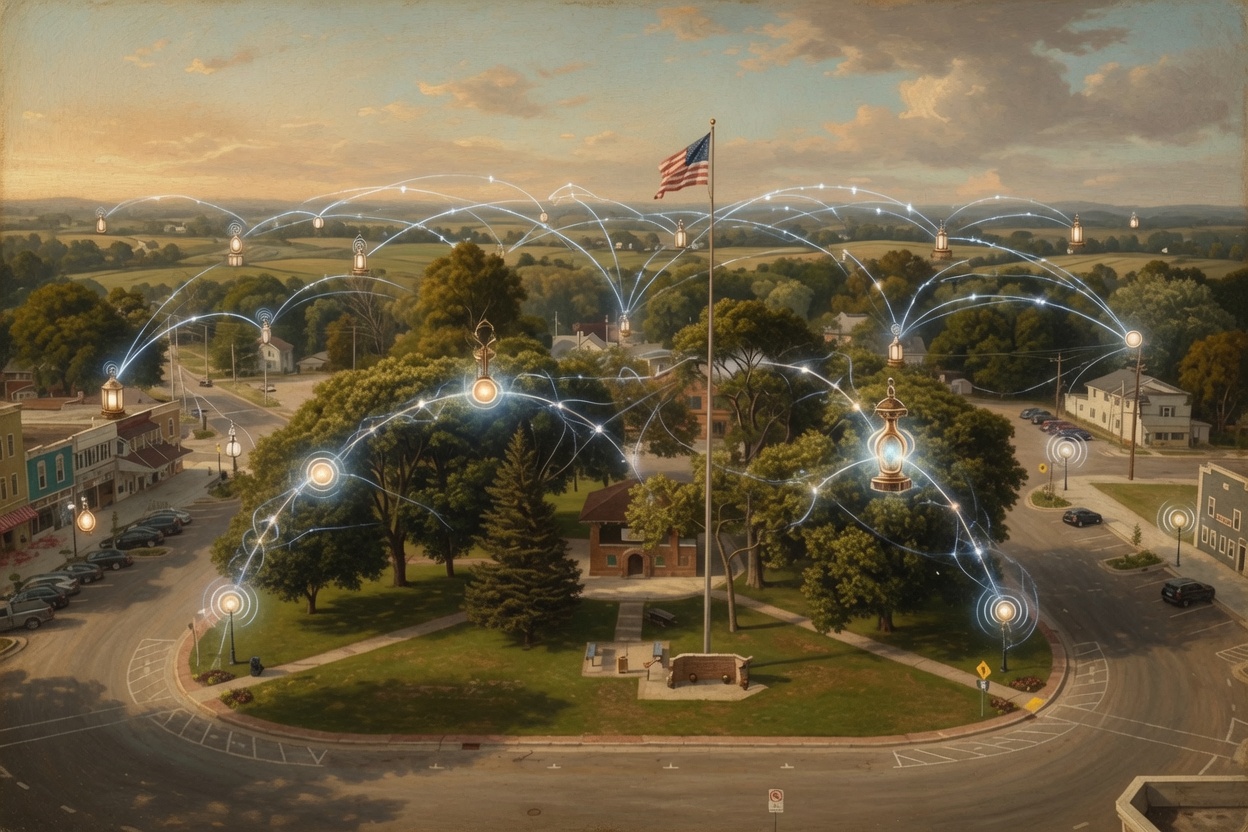
Building a Community Mesh Network in East Troy
Picture a Tuesday evening in February. Ice storm rolls through, a few poles come down on County ES, and suddenly the power is out across a chunk of the township. Cell towers run on batteries, for a while. Internet is out because the internet was never really yours to begin with. You want to check on a neighbor two miles down the road and you have no way to do it.
Now picture a different version of that evening, where you pull out a battery-powered gadget the size of a deck of cards, type a message into your phone, and it goes out over a radio network that East Troy built for itself. No cell carrier. No subscription. No towers owned by a mega-corp in Texas.
That's what we're building. It's called MeshCore, and the East Troy Computer Club has already started.
What is MeshCore?
MeshCore is open-source software for building long-range, low-power text messaging networks using inexpensive radio hardware. It runs on a technology called LoRa, short for "long range", operating in the 915 MHz band in the US.
The key things to understand:
It gets long range out of very little power. A LoRa radio putting out about a quarter of a watt can reach several miles in rolling terrain, and dozens of miles with a good repeater in the middle. It manages this by sending data very slowly — we're sending text messages, not audio and video.
It's a mesh. Repeaters up high on rooftops and towers relay for every node below them. If your radio can't hear mine directly, but we both hear a repeater on a tower up the hill, we're connected. Add more repeaters and the network gets more capable, not more congested.
It doesn't need a license. MeshCore runs on unlicensed ISM spectrum under FCC Part 15. Anyone can participate, no amateur radio license required. (Plenty of us are hams, and there's a lot of overlap in interest, but this is open to everybody.)
We're building the infrastructure. No internet, no cell service, no electricity beyond a battery and a small solar panel. Self-contained solar-powered boxes go up on roofs and towers, and they relay messages for everyone else.
It's not a replacement for the internet. You're not streaming Netflix over this. It's text messages and small bits of telemetry. Think of it as a group text thread that keeps working when nothing else does.
Why East Troy?
A few reasons this makes sense here specifically.
It's a genuinely fun project. Let's not oversell the emergency-preparedness angle. This is a great hobby. There's antennas, 3D printing, solar panels, firmware, mapping, and a real satisfaction in watching a node you built light up on a coverage map miles from your house.
We live here. We're building a network we all own. Nobody licenses it to us, nobody bills us for it, and nobody can decide it's no longer profitable to serve us.
Geography. We're in rolling glacial terrain with real elevation to work with. The Kettle Moraine ridgeline runs right past us. Terrain that's a headache for a lot of radio work is an asset here, because the high spots are genuinely high relative to the surrounding farmland.
We're a gap. There's an established MeshCore network up in the Milwaukee metro, roughly 30-some miles northeast. There's Madison Mesh about 50 miles west. Walworth and western Waukesha counties are largely empty on the map. If East Troy builds out, we're not just serving ourselves — we become part of a larger system that links half the state together.
We're rural enough for it to matter. Cell coverage out here is fine until it isn't. A network that doesn't depend on any of that has real value during storms, outages, and the kind of week where the utility trucks are still three days out. Put a repeater up on your barn and unlock reliable communication for youself and your neighbors.
What's already on the air
This isn't a proposal: it's underway.
Our first repeater node is deployed on the tower above Sauced Pizza. It's a SeeedStudio SenseCAP P1 Pro with an omnidirectional antenna, and it went up in July of 2026.
Initial mapping drives put the effective coverage across all of downtown East Troy, stretching from Guss's to Kwik Trip.
We're currently working on:
- Additional elevated sites — municipal water towers, farm silos, grain legs, and commercial rooftops
- A build night where we put together ten solar-powered repeaters and companion nodes
- Documentation and build guides so new members can get on the air without reinventing anything
"Isn't this the same thing as Meshtastic?"
You may have heard of Meshtastic, which is the better-known project in this space, and Wisconsin has an active Meshtastic community. The honest answer is that the two are similar in spirit but completely incompatible in practice. A MeshCore node and a Meshtastic node will not talk to each other, even on identical hardware.
The short version of why we picked MeshCore: it's built around dedicated infrastructure. Repeaters are a distinct role, and after an initial discovery phase, messages take a known path through the network rather than being flooded to every node every time. For a reliable network we're planning to build deliberately — towers, coverage maps, defined roles — that architecture fits what we're doing.
Meshtastic takes a more device-centric approach, and that's a completely legitimate design with a lot of happy users. Plenty of people run both. The hardware is often the same board with different firmware. If you're already in the Meshtastic world, come to the meeting anyway — we'd love to have you, and there's a lot of shared knowledge here.
How to get started
Here's the good news: getting on the network is cheap and doesn't take much.
1. Get a radio
You need a LoRa board with a 915 MHz radio. Common options in the club:
| Hardware | Roughly | Good for |
|---|---|---|
| Heltec LoRa 32 (V3/V4) | ~$25–35 | Cheapest way in; built-in display |
| SeeedStudio XIAO nRF52840 + Wio-SX1262 | ~$35–45 | Tiny, excellent battery life |
| RAK WisBlock (RAK4631) | ~$40–60 | Modular, great for custom builds |
| SeeedStudio SenseCAP P1 Pro | ~$140 | Weatherproof, outdoor/repeater use |
| LilyGO T-Deck Plus | ~$100+ | All-in-one with keyboard, no phone needed |
Prices move around — check current listings before you order. If you just want to try it, a Heltec V3 is the low-risk entry point. Don't buy a repeater-grade node until you know where you'd put it.
2. Flash the firmware
Go to flasher.meshcore.io in Chrome or Edge (it uses a browser API Firefox and Safari don't support), plug your board in with a data USB cable — not a charge-only cable, this trips up more people than anything else — pick your board, and select the "USA/Canada (Recommended)" region preset so you're on the same frequency and settings as the rest of us.
Two roles to know about:
- Companion — your personal node. Pairs to your phone over Bluetooth. This is what you want for handheld and mobile use.
- Repeater — dedicated infrastructure. No phone pairing; its whole job is relaying for everyone else. This is what goes on a roof or tower.
Please don't run a Repeater on your vehicle. A repeater that moves around confuses the network's routing and makes things worse for everyone. Mobile = Companion. We'll cover the edge cases at the meeting.
3. Install the app
Grab the MeshCore app for iOS or Android, pair it to your node over Bluetooth, set your name, and you're on the network.
4. Come say hi
Send a message. See who answers. Then start thinking about where you could put an antenna.
What we actually need
Radios are the easy part. What builds a network is height.
If you have — or know someone who has — any of the following, we'd love to talk:
- A tall barn, silo, or grain leg
- A commercial building with roof access
- Property on a ridgeline or hilltop
- A tower of any kind, ham or commercial. Even an old TV antenna tower on your house will work.
- A connection at the East Troy, Mukwonago, or Elkhown public works department
A node draws about as much power as a nightlight, weighs under a pound, and needs a spot for a small antenna. We're asking for permission and a little bit of roof space. We can handle the hardware, the install, and the maintenance.
We're also looking for people who want to help with coverage mapping — this is the easiest way to contribute. You drive around with a node and a phone running MeshMapper, and the resulting data tells us exactly where our gaps are. It's a good excuse for a Sunday drive.
A note on the project itself
One thing worth being upfront about: the MeshCore project went through a leadership split in spring of 2026, and as a result there's more than one website and more than one set of instructions floating around out there. It's confusing if you're new.
For our purposes, the resources we're using are:
- meshcore.io — main project site
- flasher.meshcore.io — the web flasher
- docs.meshcore.io — documentation
- github.com/meshcore-dev/MeshCore — source
If you land somewhere else while searching, that's why. We'll talk through the background at the kickoff meeting for anyone who's curious — it's worth understanding, and it doesn't change anything about how the network works.
Kickoff meeting
We're organizing a MeshCore kickoff session through the East Troy Computer Club. We'll cover what the network is, how to pick and set up hardware, and where we're going next — and we'll get anyone who shows up with a board flashed and on the air that night.
Sunday, August 30, 2026 — location to be determined
Bring a radio if you have one. Bring questions if you don't. Bring a friend either way.
To get in the loop before then, join us on Discord: https://discord.gg/aD5g9UuSDr
Questions? Reach out to Charlie, KD9CRQ, on Discord. If you've got a tall structure and a few minutes of curiosity, that's an even better reason to get in touch.